Innovation for tourism destinations in a changing climate
Destination Climate RiskScan is a collaborative initiative helping tourism destinations understand and respond to climate pressures, providing an evidence-based foundation for sustainable tourism adaptation, infrastructure resilience, and policy action.
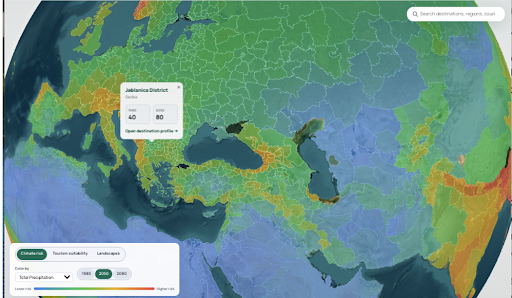
Interactive screening platform
2,588 Subnational Regions
About the Research
A global, evidence-based initiative examining climate exposure and tourism viability, developed collaboratively by Risklayer, Travel Forward and CELTH.
Global Coverage & Hazards
The Destination Climate RiskScan initiative combines climate projections with information about where tourism takes place across 2,588 subnational regions in 263 countries and territories, examining exposure to eight climate hazards alongside projected shifts in climatic suitability and seasonality for key tourism activities.
Hazard Exposure & ‘Squeezed’ Index
Climate hazard exposure is measured on a scale of 0–100, combining climate hazards with information about where tourism takes place. Higher scores indicate greater measured climate pressure. Destinations are classified as ‘squeezed’ when their exposure score increases by at least five points alongside a decline of at least five points in climatic suitability for tourism activities, or a shortening of suitable seasons by one month or more. This classification does not mean that destinations will become unviable.
Baselines & Emission Pathways
The research uses a 2010 baseline and projections to 2030, 2050 and 2080 under moderate emissions (SSP2-4.5) and high emissions (SSP5-8.5). The high-emissions pathway is used as a high-end stress test, not a prediction of the most likely future.
Scope & Review
The global results provide an initial screening of climate-related pressures, rather than a complete assessment of climate risk, as vulnerability and adaptive capacity are currently being developed for incorporation into the scores. The Destination RiskScan methodology is undergoing independent scientific review by a scientific committee of leading tourism experts.
What Destination RiskScan is Designed to Do
Destination RiskScan translates climate risk into actionable evidence-based intelligence, addressing four practical questions for every destination:
1
What climate hazards affect tourism in a destination, and how is that changing?
Multi-hazard tracking and exposure mapping across baseline and future decades, in terms of climate risks, suitability index for different tourism activities and seasonality shifts with climate change.
2
How does this compare with other places around the world?
Standardized 0–100 hazard indexing across 2,588 subnational cohorts globally.
3
How vulnerable are tourism and the wider systems on which it depends?
Selected indicators assess vulnerability and capacity across tourism-specific components and the wider enabling systems tourism depends on.
4
How well equipped is the destination to cope and adapt?
Standardized index to assess the capacity of tourism and wider enabling systems to prepare for, cope with and recover from climate impacts.
Request Interactive Demo Access
Evaluate your destination's exposure scores and explore the interactive platform. Contact the project team directly to request a test account and onboarding support.
Travel Forward is a global non-profit organisation working to advance climate action and more equitable, resilient tourism development. Travel Forward provided strategic oversight and direction, helping ensure the framework reflects tourism industry needs and supports practical application.
Destination Stewardship
Risklayer
Risklayer specializes in risk and resilience science and a global leader in tourism risk and resilience modelling. Risklayer led the overall methodological development of Destination Climate RiskScan, produced the analytical modeling of the Global Report, and developed the Destination RiskScan platform.
Risk Analytics & Modelling
CELTH
CELTH is the Centre of Expertise Leisure, Tourism and Hospitality, bringing together Breda University of Applied Sciences, NHL Stenden / European Tourism Futures Institute and Wageningen University & Research. CELTH shaped the vulnerability, capacity and transition components of the methodology.